Lately I have been hearing from many parents whose children are facing unexpected disappointments, changing plans, and uncertain futures.
Watching someone you love navigate that kind of uncertainty can stir a deep ache. The instinct to fix it, to soften it, or somehow make the path smoother than it is can be strong.
A recent essay I shared with my Substack community about this tender part of loving our children sparked an outpouring of heartfelt responses and meaningful conversations between parents and their young adult children.
Because many of you have walked with me through so many seasons of parenting, it felt important to share it here as well, in case these words are something you might need today.
One of the hardest parts of loving our children is learning to stand still when their world falls apart. There is this parental instinct that urges us to rush in and do whatever we can to pick up the pieces.
That is how I felt when my young adult daughter received news that upended the plans she had built for life after college.
As that familiar ache rose in my chest, I desperately wanted relief for her. But instead of offering certainty I couldn’t guarantee, I paused. I relied on something I have learned over the years: sometimes the most loving thing a parent can do is not promise everything will be okay but remind our children they are capable of rebuilding when it isn’t.
Later, when I reached out to ask how she was holding up, I expected to hear the heaviness I was carrying myself. Instead, my daughter’s voice was optimistic.
“I always remind myself that everything in my life that doesn’t go to plan was actually the plan all along,” Natalie said. “The best things in my life were because the original plans didn’t work.”
It was a powerful mindset—one born not from optimism alone, but from lived experience.
As she spoke, I realized I had heard echoes of this wisdom before, not in words, but in moments. Watching her steady herself in the face of disappointment carried me back to a much earlier season of motherhood, when resilience was still being formed and neither of us yet knew what it would one day make possible.
Our family had just moved to a new state, and everything familiar in my daughters’ world had suddenly disappeared—friends, routines, classrooms filled with known faces. Natalie, my older daughter, was eleven, standing at the edge of a life where nothing yet felt certain.
I can vividly recall two moments during that transitional year when I saw her pain and wanted desperately to spare her from it.
The first came when her beloved teacher abruptly left the classroom one day and never returned. For personal reasons, the teacher was unable to say goodbye. I can still hear my daughter’s guttural cries, asking why her teacher left them.
The second unfolded at the final championship of a divisional swim meet. Earlier that day, Natalie missed qualifying for finals in her event by one spot. She was invited back that evening as an alternate. This meant warming up as if she would swim, reporting to the blocks when called, scanning to see if a lane might open.
As a cautious planner with a tendency to worry, I was surprised Natalie wanted to put herself in such an unpredictable situation. But she did. I’ll never forget watching her eyes frantically scan the starting blocks, her hands clasped tightly in hope.
When no lane opened, I saw her shoulders fall. Her eyelids blinked rapidly as she fought back tears.
My child’s inner turmoil was palpable. Just like the day her teacher disappeared, her pain felt like my pain, and it was almost unbearable to witness.
In the car afterward, I told her how proud I was of her courage. I struggled with what to say next. This is what came out:
“Although the result was not what you hoped for, you gained valuable experience that will help you get through the next challenge you face. When something feels familiar, even something painful or disappointing, it becomes a little less frightening.”
I gave Natalie examples, personifying the emotions she was learning to face:
Hey disappointment, I know you. And I know you eventually pass.
Hey frustration, I’ve dealt with you before. You didn’t stop me then, and you won’t stop me now.
Hey obstacle, you tried to stop me, but I made it to the other side. That’s what I am going to do today.
I reminded her that every time she survives disappointment, she is building evidence of her own resilience.
As Natalie sat quietly in the backseat, I drove home wondering if I was cut out for parenting an adolescent. I knew that as she grew, her disappointments would deepen, and her falls would become harder. Standing by during those moments would never get easier.
But I also knew that the qualities I most hoped to nurture in my children—resilience, strength, determination, compassion—are often born from adversity. My role was not to rescue, minimize, or abandon her during struggle, but to listen, support, and believe in her ability to overcome.
The following year, Natalie earned a spot in the divisional finals. When it was time for her event, she asked me to walk with her to the starting blocks. There were no nerves this time. She was smiling… glowing, actually.
“This is what I’ve been working for all year, Mama,” she said. “I’m so happy I’m here.”
As she climbed onto the blocks, I realized that the disappointment from the year before had ignited something within her—determination shaped through effort and belief.
After her race, she walked toward a young swimmer standing poolside with tearful eyes. My daughter leaned in, gently touched her arm, and whispered something to her.
That swimmer was an alternate.
“I remember how it felt,” she told me later. “I wanted her to know she wasn’t alone.”
What Was Taking Root
Watching her comfort that young swimmer, I did not realize I was witnessing something that would echo years later. At the time, it simply felt like a small act of kindness born from shared disappointment. But now, listening to my grown daughter speak with calm acceptance about post-college plans that had fallen apart, I could see the through-line clearly. The child who once learned she could survive disappointment had become the young woman who trusted herself to begin again.
In many ways, her experience is not unusual right now. I hear similar stories again and again, young adults standing at the threshold of life while the ground beneath them shifts. Carefully laid plans dissolve. The future feels less like a roadmap and more like open water.
For those of us who love them, their uncertainty unsettles something deep within us too. And as I watch my daughter rebuild from the ground up, I realize something I wish more of us knew: resilience is not something we hand our children; it is something they discover while we stand beside them, resisting the urge to carry what they are capable of lifting themselves.
Perhaps this is especially true right now.
Disappointment in today’s world is no longer an occasional detour; it is becoming part of the landscape of modern adulthood. And perhaps the resilience our children need most is not confidence that life will go according to plan, but the belief that they can rebuild when it doesn’t.
Support does not always look like solutions.
Sometimes it looks like listening without rushing to reassure.
Sometimes it looks like reminding them who they have already proven themselves to be.
And perhaps this is true not only for our children, but for ourselves as well. Many of us are navigating endings we did not choose, plans that changed without permission, and futures that feel less predictable than we once imagined.
We, too, are learning to rebuild.
These days, when I talk with my daughter about what comes next, I notice something different in both of us. I no longer feel the same urgency to help resolve what feels uncertain, and she no longer waits for certainty before moving forward. There are still questions unanswered. But there is trust—trust in her ability to adapt, to reach out, and believe a better plan awaits.
Perhaps this is what our children need most from us in uncertain times, not a guarantee that everything will work out, but a steady presence that reminds them who they are when things don’t.
Because on the other side of disappointment is not just a different opportunity or a revised plan. On the other side is self-trust—the deep knowing that even when the path disappears, we are not lost.
Maybe that is the hope waiting for all of us right now.
Not certainty or perfect outcomes.
But the courage to keep moving forward, even without knowing exactly what comes next.
My hand in yours,
Rachel
🎶 For the Road Ahead…
On the drive to her December triathlon, Natalie and I listened to the latest album from Quinn XCII. That’s where she found Yellow Brick Road.
Lately, it’s become the song helping her move forward when things feel unclear.
As the chorus says, “As long as I keep moving, I know that I’ll be alright.”
Maybe it will steady you, too.
Listen here (with lyrics)
Supporting Each Other…
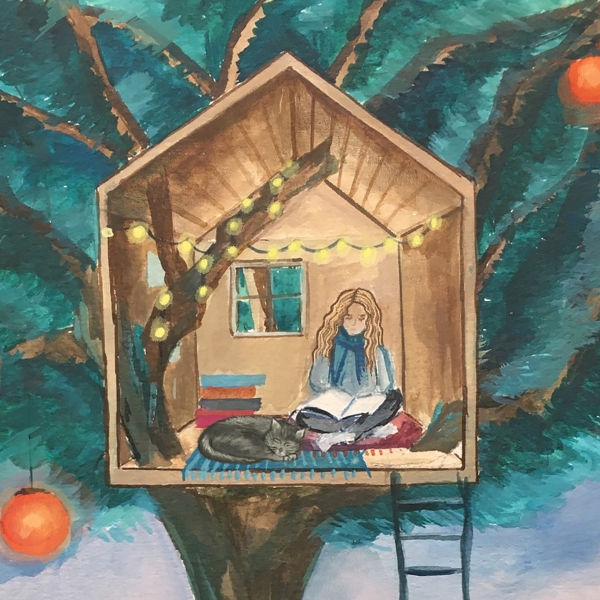
🌳 One of the most moving parts of sharing this essay in the Treehouse was the outpouring of support in the comments. Again and again, people reminded one another: we are not alone in this. So many of us are carrying deep love alongside deep uncertainty as we care for the people who matter most.
If you would like a place to feel less alone in what you are holding right now, I invite you to spend a few moments in the discussion section of the essay or add your own voice to the conversation. Your presence in Rachel’s Treehouse is a gift.
🌷If the idea of gathering with like-hearted people this spring for a chance to catch your breath and remember yourself sounds nourishing, I have one in-person gathering in 2026 — and it’s just six weeks away.
The Only Love Today Retreat was created especially for those who spend much of their lives caring for others and are ready to receive care themselves — to rest, reconnect, and rebuild a kinder relationship with their inner world.
Together we practice slowing down, listening inward, and offering ourselves the same compassion we so freely give others. Through storytelling, guided reflection, gentle practices, and supportive community, you will begin creating sustainable rituals of nourishment, rest, movement, and boundary-honoring that can travel home with you.
If this season has asked much of you, perhaps this could be a time to receive some care in return. You can learn more about the retreat here. I would love to see you on April 24!